Welcome to Hebei diao Rubber Products Co., Ltd.
Content number
Contact email

NEWS CENTER
09
2026
-
04
Silicone Hose Burst Pressure vs Working Pressure: Key Differences and Selection Guide
Author:
Silicone Hose Burst Pressure vs Working Pressure: Key Differences and Selection Guide
In industrial systems and automotive applications, the pressure performance of a silicone hose plays a critical role in overall safety and reliability. Among all technical parameters, burst pressure and working pressure are the two most important factors that must be clearly understood during selection. Burst pressure refers to the maximum pressure a silicone hose can withstand under laboratory conditions before it fails. It represents the upper limit of the hose’s strength, but it is not intended for actual operation. In contrast, working pressure is the safe pressure range at which the silicone hose can operate continuously and reliably in real-world conditions, making it the most important reference for practical use.

To ensure long-term performance and safety, a proper safety margin must always be maintained. In most applications, the recommended working pressure is typically only one-third to one-fifth of the burst pressure. This allowance helps compensate for pressure fluctuations, elevated temperatures, material fatigue, and aging over time. For example, a silicone hose with a burst pressure of 15 bar is generally recommended to operate within a working pressure range of 3 to 5 bar.

It is important to emphasize that a silicone hose should never be used near its burst pressure. Burst pressure is a one-time limit value and does not reflect sustained performance capability. Operating close to this limit can lead to serious issues such as hose swelling, structural delamination, and reinforcement layer damage. Under dynamic conditions—especially with temperature changes or pressure spikes—the risk of sudden failure increases significantly, potentially causing equipment damage and safety hazards. Therefore, working pressure—not burst pressure—should always be the basis for hose selection.

The actual pressure resistance of a silicone hose depends not only on the material itself but also on its structural design. Reinforcement layers, such as one or two layers of polyester fabric, play a crucial role in improving strength and durability. In particular, hand-built (hand-wrapped) construction provides better stability and pressure resistance compared to standard manufacturing methods. Wall thickness also contributes to higher pressure capacity, while larger diameters may reduce overall pressure performance. Additionally, high-temperature environments can weaken material strength, making it essential to choose hoses with reliable construction and sufficient safety margins.

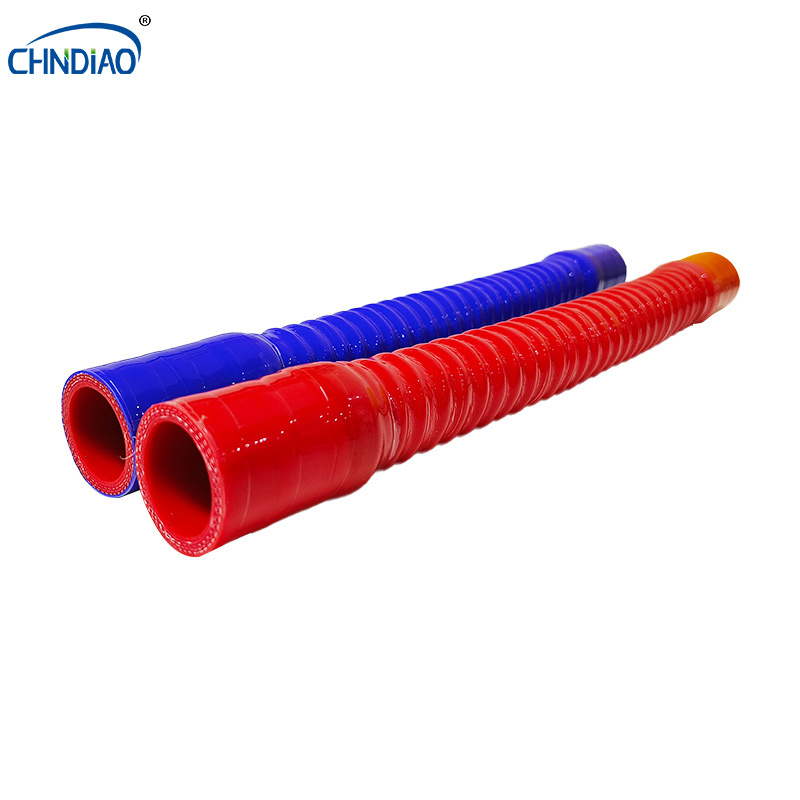
Choosing DIAO silicone hoses ensures a higher level of safety and long-term reliability. Manufactured using hand-wrapped construction combined with reinforced polyester layers, DIAO silicone hoses offer excellent pressure resistance, flexibility, and fatigue durability. They are especially suitable for automotive cooling systems and various industrial fluid transfer applications. By carefully balancing burst pressure and working pressure during product design, DIAO silicone hoses maintain structural integrity under demanding conditions, reducing the risk of swelling or delamination while extending service life and lowering maintenance costs.
silicone hose working pressure,silicone hose burst pressure,high pressure silicone hose,reinforced silicone hose,how to choose silicone hose pressure rating,automotive silicone hose pressure guide,high temperature silicone hose pressure performance,polyester reinforced silicone hose,silicone hose for cooling system pressure,industrial silicone hose pressure specifications
Previous page

Our factory specializes in the production and supply of high quality silicone hoses, food grade silicone hoses, medical silicone hoses, fuel hoses, radiator hoses, air rubber hoses, EPDM sealing strips, spiral protective covers and silicone plates and other trucks, automotive rubber accessories (support OEM and ODM).
Our address
Wangguanzhuang Town, Qinghe County, Xingtai City, Hebei Province,China